
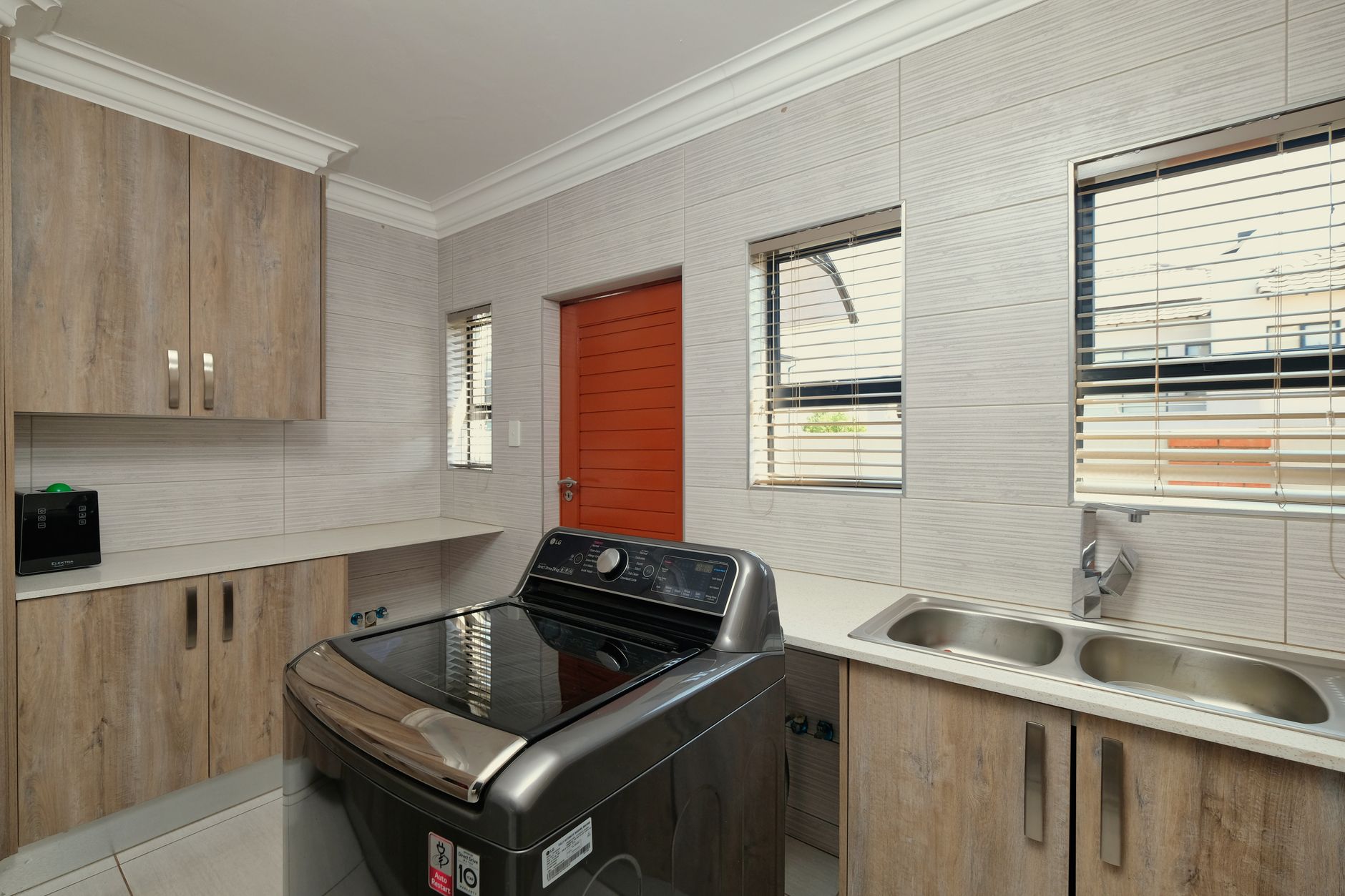
Between the washing machine, the dryer, cleaning products and clothes waiting to be folded, a laundry room packs several uses into an often limited space. Whether it is a dedicated room, a kitchen nook or a repurposed utility room, a few simple principles help organise this space so it stays practical day to day, without sacrificing its look.
Choosing the right location for a laundry room
The location of a laundry room first depends on access to a water supply and drainage, essential for the washing machine and, where applicable, for a sink. A utility room, a back kitchen, a basement or a corner of the garage that already has a water point greatly simplifies installation, avoiding extra plumbing work.
In a home without a dedicated room, a laundry corner can fit into a kitchen recess, a wide enough hallway or the space under a staircase. The key is to leave enough clearance in front of the appliances to open doors and drawers freely, and to stay close to a dedicated power outlet, since a washing machine and a dryer each draw significant power on start-up.
Ventilation deserves particular attention, especially if a vented dryer is installed: an air vent or a slightly open window limits ambient humidity and prevents mould from forming on nearby walls or cabinets. For an enclosed laundry room with no outside opening, a condenser or heat-pump dryer, which needs no air vent, remains the simplest option to install.
The floor covering also deserves attention, since a laundry room remains exposed to the risk of overflow or a small leak at the washing machine’s connections. Tiled or waterproof laminate flooring, sloped slightly towards a drain where the layout allows it, limits damage in case of an incident. A drip tray placed under the washing machine, inexpensive and easy to install, offers extra protection for homes on an upper floor, where a leak can damage the ceiling of the flat below.
Organising storage and the laundry zone
Storage organised into distinct zones makes a laundry room easier to use day to day: a zone for dirty laundry before washing, a zone for detergent and cleaning products, and a zone for clean laundry to fold or iron. Keeping these uses separate avoids piles of laundry building up on the countertop or on the floor.
Wall shelves installed above the washing machine and dryer make it possible to store detergent, fabric softener and accessories without taking up any floor space. For bulkier items, such as large detergent containers, a closed low cabinet avoids visual clutter while keeping these products within reach.
A laundry basket or bin, ideally with several compartments to separate colours, makes sorting before washing easier and avoids having to redo it when loading the machine. Fitted with wheels, this type of bin can easily be moved in front of the washing machine at wash time, then stored back against a wall afterwards.
Labelling storage, for example jars of powder detergent or bins for specific products (delicates, whites, stain removers), avoids hesitation day to day and helps every member of the household put products back in place after use. This simple organisation also limits waste, by avoiding buying a product that is already there but poorly stored.
A countertop for folding and ironing
A countertop, even a small one, makes a real difference to how comfortable a laundry room is to use: it provides a surface for folding laundry straight out of the dryer, setting down the iron, or sorting clothes before putting them away. A board installed above the washing machine and dryer, at a comfortable working height, is enough in a tight space, while a larger countertop allows a sink to be built in in bigger laundry rooms.
Choosing the right equipment
Whether to place the washing machine and dryer side by side or stacked depends above all on the available space. Stacking, using a stacking kit designed for both appliances, frees up a floor width equivalent to a single appliance, a decisive advantage in a narrow laundry room or a corner set up in a hallway.
A sink, even a small one, brings real comfort for pre-treating a stain, hand-washing a delicate item or rinsing shoes, without having to use the kitchen or bathroom sink. A mixer tap with a pull-out hose makes it easier to fill buckets or water indoor plants kept in this room.
A drying rack, fixed or retractable, usefully rounds out a laundry room’s equipment, particularly in homes with no outdoor space where air-drying outside is not possible. A ceiling- or wall-mounted retractable model folds away once the laundry is dry and fully frees up the walking space the rest of the time.
Limiting noise and vibration
The washing machine and dryer are among the noisiest appliances in a home, particularly during the spin cycle. Placing the appliances on an anti-vibration mat or rubber pads significantly reduces the vibration transmitted to the floor and load-bearing walls, an important point when the laundry room is next to a bedroom or located upstairs in a house. Checking that the appliances are level, using the adjustable feet, also limits the machine moving during a cycle and the noise that results from it.
Consider refurbished appliances
To equip a laundry room without investing in brand-new equipment, refurbished appliances offer a reliable alternative for a washing machine as much as for a dishwasher, complete with a warranty and a functional check carried out before resale.
Fitting a laundry room into a small space
In a studio flat, an apartment or a house with no dedicated room, a laundry corner can often be fitted into a recess just a few tens of centimetres wide. A custom tall cabinet that frames the stacked washing machine and dryer, closed off with sliding or hinged doors, hides the appliances the rest of the time.
The space under a staircase, often left empty or underused, can house a washing machine on its own or a small storage space for cleaning products, provided the available height and access to a water supply are checked beforehand. A custom-made cabinet, shaped to follow the slope of the ceiling, makes better use of this kind of irregular space than a standard cabinet.
In a kitchen, a recess around 60 centimetres wide is often enough to fit a washing machine under a countertop, provided a discreet connection is planned and a panel is added to blend it visually with the rest of the kitchen cabinets. A door matching the kitchen fronts, fitted in front of the appliance, fully hides this technical space while keeping easy access for maintenance and routine repairs.
The storage tips for a small space that apply to the rest of a home work just as well in a compact laundry room: shelving up to the ceiling, wall storage with no drilling required, and multi-purpose furniture all help gain a significant amount of storage without enlarging the room itself.
What budget to plan for a laundry room
The budget for a laundry room project varies widely depending on its scope, from simply adding shelves to fitting a custom cabinet with a countertop and a plumbed water point.
| Level of fit-out | Elements included | Indicative budget |
|---|---|---|
| Essential | Wall shelves, laundry basket, storage rail | €50 to €150 |
| Intermediate | Low cabinet, simple countertop, retractable drying rack | €300 to €800 |
| Complete | Custom cabinet, countertop with sink, plumbing work | €1,500 to €4,000 |
These figures give an order of magnitude and vary depending on the materials chosen, the size of the room, and whether a professional is hired for plumbing or electrical work. A gradual approach, starting with storage before adding a countertop or a water point later on, makes it possible to spread this cost out over time.
Colours and materials suited to a laundry room
A laundry room, often a windowless or small space, benefits from light colours on the walls and upper cabinets, which better reflect the available light and reduce the feeling of being enclosed. White, light grey or pastel shades remain safe choices for this use.
Materials also need to withstand the ambient humidity, which is higher than in the rest of the home because of the washing machine and clothes drying. Waterproof tile or laminate flooring, cabinets in melamine or wood treated against moisture, and paint designed for damp rooms all limit the risk of deterioration over time.
To add character without weighing down a space people pass through, a single bolder splash of colour on one element, such as a cabinet door or a splashback, is usually enough. This principle echoes the one applied when laying out a small bathroom, another technical room where the balance between function and looks rests on similar choices of colour and materials.
For furniture or storage accessories still missing, furniture websites often carry compact pieces designed for laundry rooms and small technical spaces, a useful option when the available dimensions fall outside the usual standards.
When the home has an outdoor space, even a small one, part of what a laundry room is used for can move outside, particularly for drying clothes in fine weather. This logic of extending living space outdoors echoes the principles used when designing a terrace on a small budget, where a few well-chosen elements are enough to add extra use without a large investment.