
Choosing a thermal insulation material directly affects a home’s comfort and the size of its heating or cooling bills. Between mineral, synthetic and bio-based insulants, the differences in performance, thickness and price are significant, and the right choice depends above all on the wall, roof or floor being insulated and on the constraints of the project. This guide compares the main families of insulation materials and explains how to make the right choice for a given project.
Comparing thermal insulation materials
The table below places the main insulation materials by their thermal conductivity (lambda: the lower it is, the better the material insulates), the thermal resistance R they provide for 10 cm of thickness, an indicative price range and their most common use.
| Insulant | Lambda (W/m.K) | R for 10 cm (m².K/W) | Indicative price (€/m²) | Common use |
|---|---|---|---|---|
| Glass wool | 0.030 to 0.040 | 2.5 to 3.3 | 5 to 15 | Attics, interior walls |
| Rock wool | 0.035 to 0.040 | 2.5 to 2.9 | 8 to 20 | Attics, walls, roofs |
| Cellulose wadding | 0.038 to 0.042 | 2.4 to 2.6 | 15 to 25 | Loft spaces, walls |
| Wood fibre | 0.036 to 0.045 | 2.2 to 2.8 | 20 to 35 | Walls, under roofing |
| Expanded polystyrene (EPS) | 0.029 to 0.038 | 2.6 to 3.4 | 10 to 20 | Walls, floors, external insulation |
| Extruded polystyrene (XPS) | 0.029 to 0.035 | 2.9 to 3.4 | 15 to 30 | Floors, foundations, damp areas |
| Polyurethane (PU/PIR) | 0.022 to 0.028 | 3.6 to 4.5 | 20 to 40 | Roofs, walls with limited thickness |
| Vacuum insulation panel (VIP) | 0.007 to 0.009 | 11 to 14 | 60 to 120 | Renovation with very limited thickness available |
These values vary by manufacturer and by specific product: they give an order of magnitude for comparing the main families of insulation materials, not a guaranteed value for any single product. At a similar price per square metre, two insulants can require very different thicknesses to reach the same thermal resistance R, which is why price per square metre of material alone never says enough: it always needs to be weighed against the thermal resistance actually achieved once installed.
How to choose insulation for a project
Choosing a thermal insulation material rests on three criteria that work together: the performance needed, the thickness available and the budget. Thermal conductivity, noted lambda and expressed in W/m.K, shows how easily a material lets heat pass through: the lower this value, the better the insulant performs at an equal thickness. Thermal resistance R, calculated by dividing the installed thickness by lambda, is the indicator to look at first, since it determines eligibility for renovation grants.
For a project where space is not a constraint, such as a loft space, a standard mineral or bio-based insulant is usually the most economical choice for a given thermal resistance. Conversely, for a renovation where the available thickness is limited, for example on an interior wall in a smaller home, a higher-performance synthetic insulant, or even a vacuum insulation panel in the most constrained cases, reaches the target resistance level without eating too much into living space.
The type of surface being insulated also shapes the choice: insulating a damp or below-ground area, such as a floor or foundation, calls for a material that handles moisture well, which points towards extruded polystyrene or certain mineral insulants treated for this use. For insulation against summer heat, thermal phase shift, meaning how long heat takes to cross the wall, deserves as much attention as winter R-value: bio-based insulants such as wood fibre or cellulose wadding stand out here thanks to their higher density.
Current building regulations set minimum R-values to reach for each type of surface in order for a project to remain eligible for grants: these thresholds are generally higher for attics, which are easy to access and cheap to insulate heavily, than for walls or ground floors, where available thickness is often more limited. Aiming above the regulatory minimum, when thickness allows, cuts heating bills further over the lifespan of the insulant, which usually exceeds several decades for a material correctly installed and protected from moisture.
The budget set aside for the material itself is also only part of the total cost of an insulation project: labour, removing existing damaged insulation, fitting a vapour barrier or an airtightness membrane, and finishing work (plasterboard, cladding, render) often weigh more heavily than the price per square metre of the insulant itself, especially for interior or exterior wall insulation.
Mineral insulants: glass wool and rock wool
Glass wool and rock wool form the most widely used family of mineral insulants in France, sold in rolls, semi-rigid panels or loose-fill for blown-in installation. Made from sand and recycled glass for the former and from volcanic rock for the latter, they offer a good balance between thermal performance and price, with notable fire resistance, particularly for rock wool.
These insulants suit most common uses: loft spaces or converted attics, interior walls, partitions. Installing them remains accessible to a competent DIYer for a loft space, unlike some more technical installations that call for a professional. One point of caution concerns their sensitivity to moisture, which can reduce their performance over time if a vapour barrier is not installed correctly.
Available in rolls for accessible loft spaces, in semi-rigid panels for rafters and walls, or as loose-fill for mechanical blowing into hard-to-reach attics, glass wool and rock wool cover nearly every site configuration. Rock wool generally offers better fire resistance and slightly better sound insulation than glass wool, two useful arguments for insulating party walls or floors between storeys, while glass wool usually remains a little cheaper at an equivalent thermal resistance for simply filling a loft space.
Synthetic insulants: polystyrene and polyurethane
Synthetic insulants include expanded polystyrene (EPS), extruded polystyrene (XPS) and polyurethane (PU, sometimes called PIR in its rigid form). Derived from petrochemicals, they stand out for a lower thermal conductivity than mineral insulants, which makes it possible to reach good thermal resistance with a reduced thickness.
Extruded polystyrene holds up particularly well against moisture and compression, which makes it a suitable material for floors, foundations and exterior insulation at foundation level. Polyurethane, more expensive, offers one of the best performances per centimetre of thickness among common insulants, an advantage for renovations where space is tight, for example under a roof with already low ceiling height.
Expanded polystyrene, less dense and less expensive than the extruded version, remains a common choice for external wall insulation under render on new or renovated walls, as well as for filling floor cavities. It handles continuous exposure to standing moisture less well than extruded polystyrene, which is why the latter is preferred for the areas most exposed to water, such as slabs on grade. Polyurethane most often comes as rigid, pre-faced panels, sometimes with an integrated vapour barrier, which simplifies installation on roofs and interior walls where airtightness needs to be flawless. These synthetic insulants are, however, more sensitive to fire than mineral insulants, which usually requires protection with plasterboard or a non-combustible facing on the interior side.
Bio-based and natural insulants
Wood fibre, cellulose wadding, hemp, flax and cork make up the family of bio-based insulants, derived from renewable or recycled raw materials. Their higher density compared with mineral insulants gives them a better thermal phase shift, a clear advantage for limiting the heat that builds up in attics or under roofing during summer days.
Cellulose wadding, made from recycled paper treated against fire and insects, is mostly installed by blowing it into loft spaces. Wood fibre comes in semi-rigid panels, used both for interior wall insulation and under rafters. These insulants generally cost more than mineral insulants at an equivalent resistance, a gap that is justified by their summer comfort and more favourable environmental footprint.
Hemp and flax, often combined with recycled cotton or sheep’s wool in semi-rigid panels, are particularly well suited to interior wall insulation in older homes, where their ability to regulate ambient humidity limits the risk of condensation in stone or timber-frame walls. Cork, more marginal because of its higher price, stands out for its long-term stability, its natural resistance to rot and its possible use in both interior and exterior insulation under render. All of these bio-based materials share a high mass heat capacity, which slows the temperature rise inside a room during a heat spike outside, an advantage that matters more as heatwaves become more frequent in summer.
Insulating walls, attics and floors: which material for which surface
For attics, which account for the largest share of heat loss in a poorly insulated home, glass wool, rock wool or blown-in cellulose wadding cover most needs, with a good balance of performance and price over a large surface area.
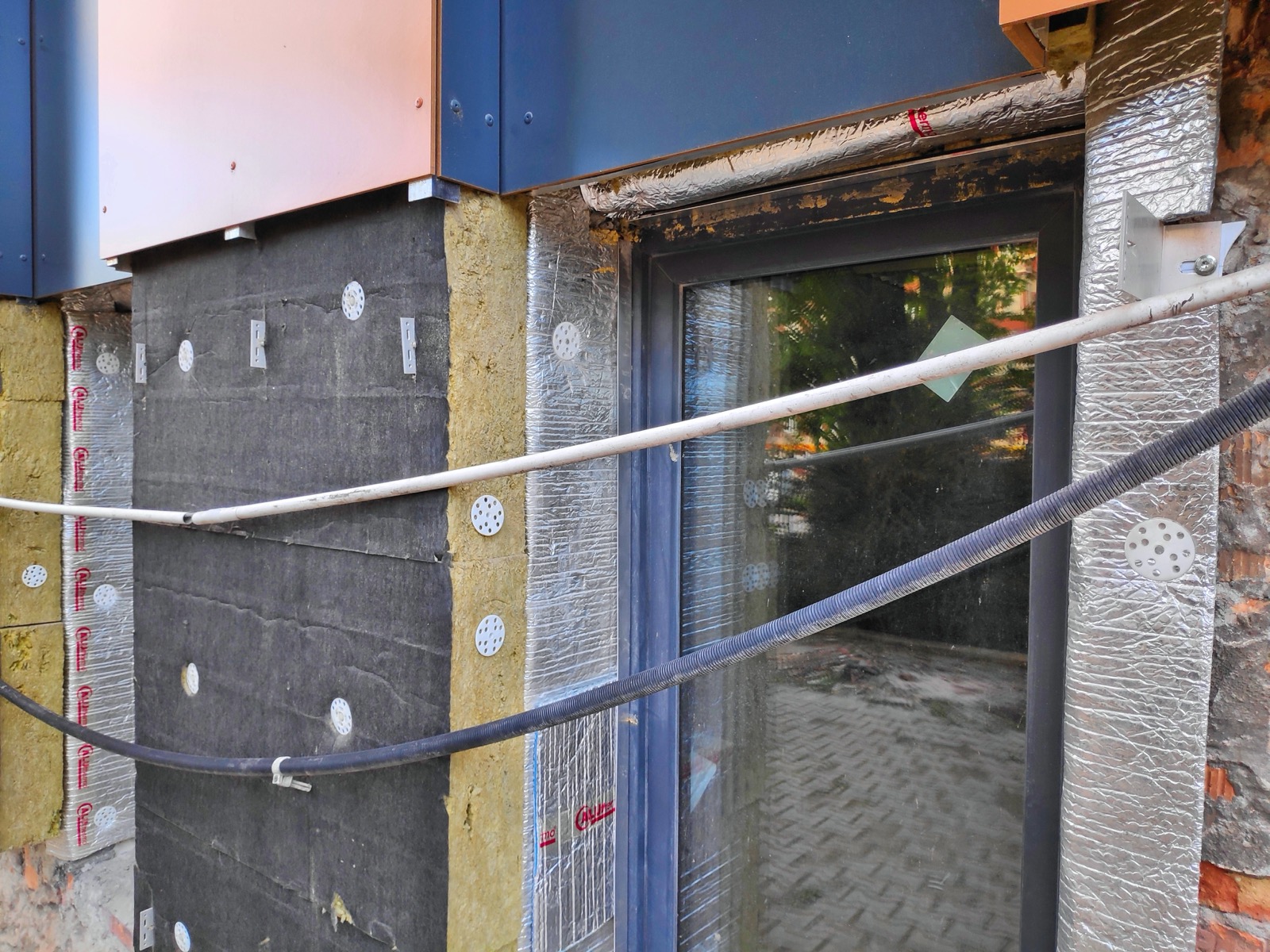
For walls, interior insulation favours semi-rigid panels or rolls that are easy to fit between a frame, in mineral wool or wood fibre, while exterior insulation leans more towards expanded polystyrene panels or rigid rock wool, installed under render or cladding. For floors and foundations, exposed to moisture, extruded polystyrene remains one of the most widely used materials thanks to its resistance to water and to compression under load.
Exterior insulation offers an advantage that interior insulation does not: it removes most of the thermal bridges at floor slabs and load-bearing walls, the points where the building’s structure breaks the continuity of the insulation. It also does not reduce living space, unlike interior insulation, which takes a few centimetres off every room. It remains more expensive and more complex to carry out, however, particularly on a facade with decorative features to preserve, which is why interior insulation remains the most common choice for everyday renovation.
For converted attics under rafters, the thickness available between the rafters often limits the choice to insulants that perform well per centimetre, such as high-density rock wool or polyurethane, complemented if needed by a second, crossed layer to remove thermal bridges at the rafters themselves. For a ground floor above a crawl space or an unheated garage, insulation is most often fitted from below, in rigid polystyrene or polyurethane panels fixed directly under the floor.
Grants for insulation work
Thermal insulation work can qualify for several grants, provided it is carried out by a certified RGE professional: MaPrimeRénov’, the energy savings certificate scheme (CEE), and in some cases additional local grants. The thermal resistance R achieved often determines the amount of the grant, which is an incentive to aim for solid performance rather than the regulatory minimum.
The exact steps and amounts should be checked before work begins, since the scales change regularly and grants can be combined under rules specific to each scheme. The official France Rénov’ platform centralises up-to-date conditions and points towards an independent adviser to estimate the remaining cost of an insulation project.
Under most grant schemes, the amount awarded depends on the surface area insulated, the thermal resistance R achieved and household income, with more generous scales for lower-income households. Grants must always be applied for before signing the quote with the contractor, never after work has started, or the benefit of the scheme is lost. Keeping invoices, the contractor’s RGE certificate and income documents makes it easier to file and process the application afterwards.
DIY installation or hiring a professional
Some insulation work remains accessible to a DIYer comfortable with basic tools, in particular insulating a loft space with rolled mineral wool or cellulose wadding, where the job mainly consists of unrolling and fitting the material between the joists. Other work calls for more technical skill: exterior wall insulation, fitting a continuous and properly sealed vapour barrier, or blowing in cellulose wadding, which requires specific equipment.
Hiring a certified RGE professional brings a double benefit: installation that follows proper standards, avoiding thermal bridges and moisture problems linked to poor airtightness, and access to grants that are only awarded for work carried out by this type of professional. For a project that affects the building’s structure or several surfaces at once, getting a quote from a qualified contractor remains the safest way to secure both the thermal result and the financing of the project.
Before taking on the work alone, a few checks avoid unpleasant surprises: making sure the supporting frame or structure shows no sign of damp or mould to treat before installation, providing enough ventilation so the insulation does not trap ambient humidity, and never blocking the air vents built into the home’s ventilation system. For a project carried out in stages, insulating the attic first is usually the quickest payback, before moving on to walls or the ground floor later, depending on the budget available each year.